Case Study

Building an AI trip planner

Building an AI trip planner

AI Trip Planner

The Project

Building Confidence Before the Booking. An AI Trip Planner.

An LLM-based trip planner that lets customers plan upcoming travel through natural language and visualise the trip chronologically before any booking is made. Operating principles, conversation patterns, and strategic positioning defined and aligned across product, engineering, commercial, and legal before build. A design language for AI-native travel planning where most companies are still bolting on chatbots.

Product

AI Trip Planner

Project

Primary Travel Verticals

Year

2026 (In active development, foundational design phase)

Focus

UX Strategy, Vision, AI LLM UX, Coaching Senior Designer

The Project

Building Confidence Before the Booking. An AI Trip Planner.

An LLM-based trip planner that lets customers plan upcoming travel through natural language and visualise the trip chronologically before any booking is made. Operating principles, conversation patterns, and strategic positioning defined and aligned across product, engineering, commercial, and legal before build. A design language for AI-native travel planning where most companies are still bolting on chatbots.

Product

AI Trip Planner

Project

Primary Travel Verticals

Year

2026 (In active development, foundational design phase)

Focus

UX Strategy, Vision, AI LLM UX, Coaching Senior Designer

Outcomes

The impact in numbers.

Building Confidence Before the Booking

The Problem

Booking travel is high-stakes and high-friction. Research showed clearly that asking customers to commit to an entire trip in one transaction drives bounce, not conversion. Planning is fragmented: flights, hotels, cars, activities, all in separate searches, leaving the customer to hold the whole trip together in their head. The AI tools entering the space were leaning into urgency and cross-sell, which the research suggested would amplify bounce.

The brief, as framed: how do you build an AI that accelerates planning without driving urgency, integrates with the booking surface without disrupting it, and earns its place next to a search bar that already converts?

We didn't ask "how do we add AI to the booking flow?" It was "how do we replace urgency with confidence at the planning stage?"

The Approach: three positions I guided the work toward
Confidence over urgency.

The AI builds the trip with the customer so they can visualise it before committing. Chronological itinerary view, customers see the trip the way they'll live it. Save now, book later removes the all-or-nothing pressure that research showed was costing conversions.

Helpful by default, not pushy.

Cross-sell exists, but it never leads. When the AI proposes a transfer from the airport over a taxi, it explains why: distance, late arrival, luggage. Context earns the suggestion. The customer can take it or skip it without friction.

Infer first, ask only what's needed.

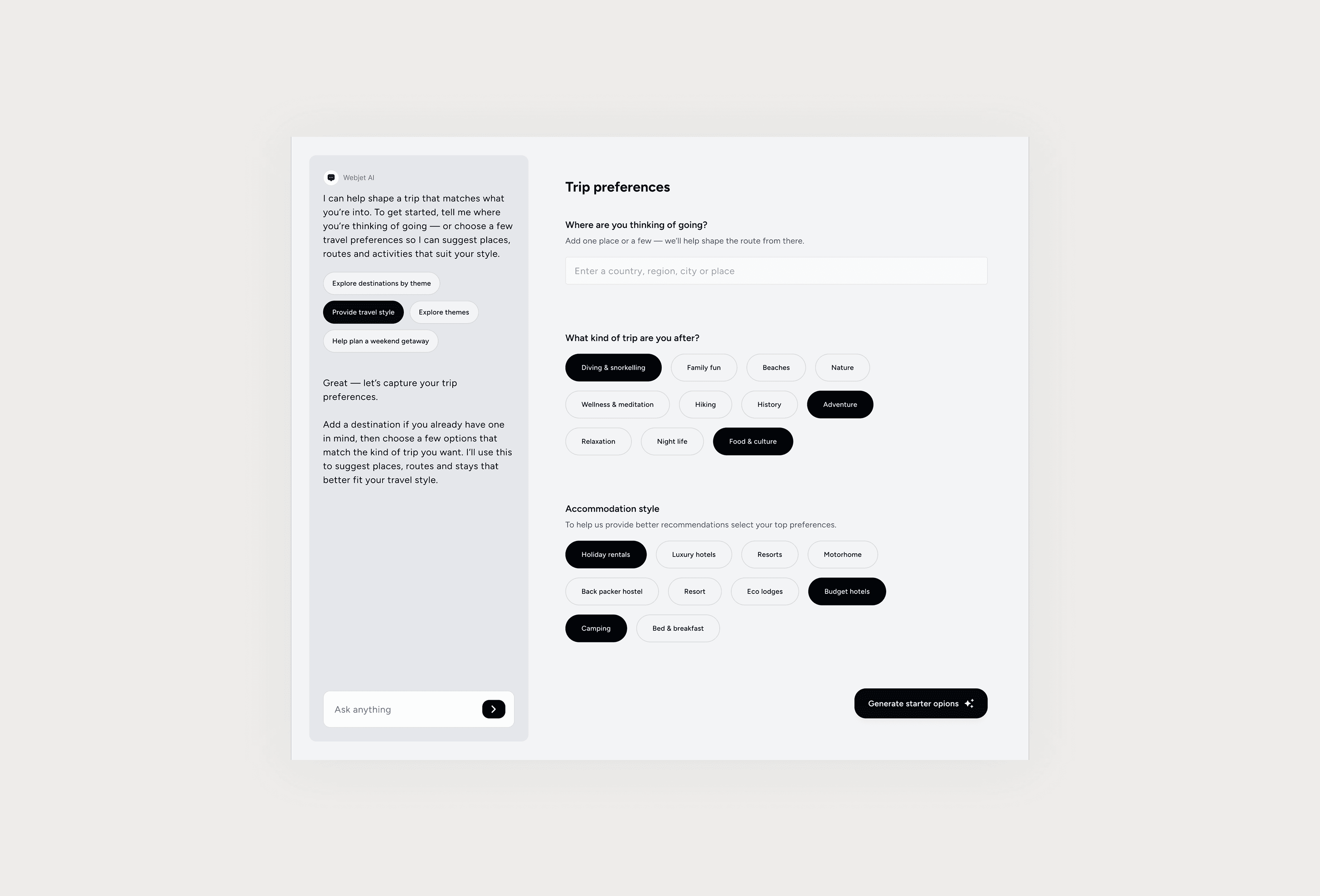
The AI uses what it knows (trip details, traveller profile, prior conversation) before opening its mouth. Surface tiles in the UI accelerate chat rather than replace it. System prompts encode product strategy, rules like "over 5 nights, suggest multi-location" or "confirm visa requirements before any purchase link" are commercial and compliance decisions in prompt form.

Structure at transactional moments. Flexibility everywhere else.

Building Confidence Before the Booking

The Problem

Booking travel is high-stakes and high-friction. Research showed clearly that asking customers to commit to an entire trip in one transaction drives bounce, not conversion. Planning is fragmented: flights, hotels, cars, activities, all in separate searches, leaving the customer to hold the whole trip together in their head. The AI tools entering the space were leaning into urgency and cross-sell, which the research suggested would amplify bounce.

The brief, as framed: how do you build an AI that accelerates planning without driving urgency, integrates with the booking surface without disrupting it, and earns its place next to a search bar that already converts?

We didn't ask "how do we add AI to the booking flow?" It was "how do we replace urgency with confidence at the planning stage?"

The Approach: three positions I guided the work toward
Confidence over urgency.

The AI builds the trip with the customer so they can visualise it before committing. Chronological itinerary view, customers see the trip the way they'll live it. Save now, book later removes the all-or-nothing pressure that research showed was costing conversions.

Helpful by default, not pushy.

Cross-sell exists, but it never leads. When the AI proposes a transfer from the airport over a taxi, it explains why: distance, late arrival, luggage. Context earns the suggestion. The customer can take it or skip it without friction.

Infer first, ask only what's needed.

The AI uses what it knows (trip details, traveller profile, prior conversation) before opening its mouth. Surface tiles in the UI accelerate chat rather than replace it. System prompts encode product strategy, rules like "over 5 nights, suggest multi-location" or "confirm visa requirements before any purchase link" are commercial and compliance decisions in prompt form.

Structure at transactional moments. Flexibility everywhere else.
Section

How I worked

My Senior Designer led execution. I was the consult on direction, the pressure-test on decisions, and the bridge between cross-functional stakes (product, engineering, commercial, legal) and the design patterns that held the experience together.

A few short calls a day on direction. Never on pixels.

How We Planned to Validate

Forward-looking. Validation planned in three layers: behavioural (question-to-recommendation ratios, session completion, booking conversion when the customer returns), qualitative (usability on conversational flows, focused on whether the AI feels helpful or interrogative), commercial (attach rate vs traditional booking, controlled for customer segment).

The bet: an AI that builds confidence will outperform one that defaults to urgency. The validation will tell us whether the position was right.

Strategy, craft, and delivery, end-to-end.

Design leadership that holds the thread from problem to outcome. If you need someone who can lead from the front without losing the craft, you've found them.

2026 · Rob Nastos · Product Design Leader

Strategy, craft, and delivery, end-to-end.

Design leadership that holds the thread from problem to outcome. If you need someone who can lead from the front without losing the craft, you've found them.

2026 · Rob Nastos · Product Design Leader

Strategy, craft, and delivery, end-to-end.

Design leadership that holds the thread from problem to outcome. If you need someone who can lead from the front without losing the craft, you've found them.

2026 · Rob Nastos · Product Design Leader